About Bolivia (Plurinational State of)
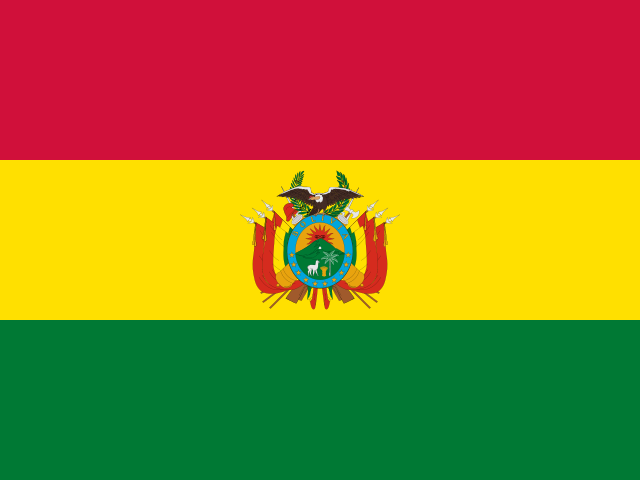
Region: Latin America and the Caribbean
Area: 1,098,580 km²
Population: 12,413,315
Libraries in Bolivia (Plurinational State of)
Bolivia lacks a national system of libraries. Existing library networks are primarily institutional or specialised.
In terms of library types, most country’s libraries are school, academic and university libraries with a small number of specialised libraries.
There is no ministry of governmental agency who would be responsible for development of library policies and legislation. Libraries are budgetarily dependent on their institutions.
Technology training and diversification of library services are two main priorities for librarians. In addition, the library sector dedicates quite a lot of effort to form and reactivate library associations.
The College of Professionals in Information Sciences of Bolivia (Colegio de Profesionales en Ciencias de la Información de Bolivia, CPCIB in Spanish) is the only library association acting at the national level. There are several departmental associations which each act in their respective department. Currently active departmental associations include:
- Association of Librarians of Beni (Asociación de Bibliotecarios del Beni, ABB)
- Association of Librarians of Oruro (Asociación de Bibliotecarios de Oruro, ABO)
- Association of Librarians and Archivists of Chuquisaca (Asociación de Bibliotecarios y Archivistas de Chuquisaca, ABACH)
- Association of Librarians of Quillacollo Province (Asociación de Bibliotecarios de la Provincia de Quillacollo)
- Association of Librarians of Santa Cruz (Asociación de Bibliotecarios de Santa Cruz, ABCRUZ)
The associations are dedicated both to the training and upgrading of their members as well as strengthening their own capacity.
Both, the CPCIB and the departmental associations, are working together on such projects as the provision of training courses on the topics of the IFLA’s Global Vision, Sustainable Development Goals, and providing contents to the Library Map of the World.
Each departmental association in their department periodically organises training and refresher courses, talks, and various other activities for the benefit of its members.
The CPCIB has about 200 members and the departmental associations all together register a total of approximately 300 people throughout the country.
Contextual data
|
Population |
Bolivia (Plurinational State of) |
Region |
World |
|---|---|---|---|
|
Population Total population is based on the de facto definition of population, which counts all residents regardless of legal status or citizenship. The values shown are midyear estimates. |
12,413,315 2024 |
662,186,388 2024 |
8,141,808,945 2024 |
|
Proportion of Population Younger than 15 Age dependency ratio, young, is the ratio of younger dependents--people younger than 15--to the working-age population--those ages 15-64. Data are shown as the proportion of dependents per 100 working-age population. |
46.1% 2024 |
33.3% 2024 |
38.0% 2024 |
|
Proportion of Population Older than 64 Age dependency ratio, old, is the ratio of older dependents--people older than 64--to the working-age population--those ages 15-64. Data are shown as the proportion of dependents per 100 working-age population. |
8.7% 2024 |
14.5% 2024 |
15.7% 2024 |
|
Population Growth Annual population growth rate for year t is the exponential rate of growth of midyear population from year t-1 to t, expressed as a percentage. Population is based on the de facto definition of population, which counts all residents regardless of legal status or citizenship. |
1.4% 2024 |
1 2024 |
1.0% 2024 |
|
Population Density Population density is midyear population divided by land area in square kilometers. Population is based on the de facto definition of population, which counts all residents regardless of legal status or citizenship--except for refugees not permanently settled in the country of asylum, who are generally considered part of the population of their country of origin. Land area is a country's total area, excluding area under inland water bodies, national claims to continental shelf, and exclusive economic zones. In most cases the definition of inland water bodies includes major rivers and lakes. |
11.3% 2023 |
32.6% 2022 |
61.6% 2022 |
|
Urban Population Urban population refers to people living in urban areas as defined by national statistical offices. The data are collected and smoothed by United Nations Population Division. |
71.2% 2024 |
81.3% 2024 |
57.6% 2024 |
|
Information Infrastructure |
Bolivia (Plurinational State of) |
Region |
World |
|---|---|---|---|
|
Internet Users Internet users are individuals who have used the Internet (from any location) in the last 3 months. The Internet can be used via a computer, mobile phone, personal digital assistant, games machine, digital TV etc. |
70.2% 2023 |
83.7% 2025 |
73.6% 2025 |
|
Female Internet Users This indicator refers to female individuals who have used the Internet (from any location) in the last 3 months. The Internet can be used via a computer, mobile phone, personal digital assistant, games machine, digital TV etc. |
63.7% 2021 |
81.3% 2024 |
68.2% 2024 |
|
Male Internet Users This indicator refers to male individuals who have used the Internet (from any location) in the last 3 months. The Internet can be used via a computer, mobile phone, personal digital assistant, games machine, digital TV etc. |
- |
81.3% |
- |
|
Access to Electricity Access to electricity is the percentage of population with access to electricity. Electrification data are collected from industry, national surveys and international sources. |
99.8% 2023 |
98.4% 2023 |
91.6% 2023 |
|
Economy, Poverty, and Employment |
Bolivia (Plurinational State of) |
Region |
World |
|---|---|---|---|
|
GDP per Capita This indicator provides values for gross domestic product (GDP) expressed in current international dollars, converted by purchasing power parities (PPPs). PPPs account for the different price levels across countries and thus PPP-based comparisons of economic output are more appropriate for comparing the output of economies and the average material well-being of their inhabitants than exchange-rate based comparisons. Gross domestic product is the total income earned through the production of goods and services in an economic territory during an accounting period. It can be measured in three different ways: using either the expenditure approach, the income approach, or the production approach. This series has been linked to produce a consistent time series to counteract breaks in series over time due to changes in base years, source data and methodologies. Thus, it may not be comparable with other national accounts series in the database for historical years. The core indicator has been divided by the general population to achieve a per capita estimate. This indicator is expressed in current prices, meaning no adjustment has been made to account for price changes over time. The PPP conversion factor is a currency conversion factor and a spatial price deflator. PPPs convert different currencies to a common currency and, in the process of conversion, equalize their purchasing power by eliminating the differences in price levels between countries, thereby allowing volume or output comparisons of GDP and its expenditure components. |
12,878 2024 |
23,104.6 2024 |
24,526 2024 |
|
Poverty Rate Poverty headcount ratio at $3.00 a day is the percentage of the population living on less than $3.00 a day at 2021 purchasing power adjusted prices. As a result of revisions in PPP exchange rates, poverty rates for individual countries cannot be compared with poverty rates reported in earlier editions. |
2.8% 2023 |
4.5% 2024 |
10.3% 2024 |
|
Inequality Gini index measures the extent to which the distribution of income (or, in some cases, consumption expenditure) among individuals or households within an economy deviates from a perfectly equal distribution. A Lorenz curve plots the cumulative percentages of total income received against the cumulative number of recipients, starting with the poorest individual or household. The Gini index measures the area between the Lorenz curve and a hypothetical line of absolute equality, expressed as a percentage of the maximum area under the line. Thus a Gini index of 0 represents perfect equality, while an index of 100 implies perfect inequality. |
42.1% 2023 |
0.0% |
- |
|
Unemployment Unemployment refers to the share of the labor force that is without work but available for and seeking employment. Definitions of labor force and unemployment differ by country. |
2.7% 2024 |
5.3% 2024 |
6.2% 2021 |
|
Inactive Youth The share of youth not in education, employment or training (also known as “the NEET rate”) conveys the number of young persons not in education, employment or training as a percentage of the total youth population. Youth not in education are those who were neither enrolled in school nor in a formal training program (e.g. vocational training). For the purposes of this indicator, youth is defined as all persons between the ages of 15 and 24 (inclusive). percentage of youth population |
8.0% 2024 |
18.6% 2024 |
- |
|
Education and Literacy |
Bolivia (Plurinational State of) |
Region |
World |
|---|---|---|---|
|
Education Spending General government expenditure on education (current, capital, and transfers) is expressed as a percentage of GDP. It includes expenditure funded by transfers from international sources to government. General government usually refers to local, regional and central governments. percentage of GDP |
8.3% 2023 |
3.8% 2023 |
3.5% 2023 |
|
Adult Literacy Rate Adult literacy rate is the percentage of people ages 15 and above who can both read and write with understanding a short simple statement about their everyday life. percentage of people ages 15 and above |
95.6% 2023 |
3.8% 2023 |
87.7% 2024 |
|
Female Adult Literacy Adult literacy rate is the percentage of people ages 15 and above who can both read and write with understanding a short simple statement about their everyday life. percentage of females ages 15 and above |
93.5% 2023 |
94.7% 2024 |
84.6% 2024 |
|
Male Adult Literacy Adult literacy rate is the percentage of people ages 15 and above who can both read and write with understanding a short simple statement about their everyday life. percentage of males ages 15 and above |
93.5% 2023 |
95.2% 2024 |
90.9% 2024 |
|
Female Youth Literacy Youth literacy rate is the percentage of people ages 15-24 who can both read and write with understanding a short simple statement about their everyday life. percentage of females ages 15-24 |
99.6% 2023 |
98.9% 2024 |
92.0% 2024 |
|
Male Youth Literacy Youth literacy rate is the percentage of people ages 15-24 who can both read and write with understanding a short simple statement about their everyday life. percentage of males ages 15-24 |
99.4% 2023 |
98.5% 2024 |
94.1% 2024 |
|
Research and Innovation |
Bolivia (Plurinational State of) |
Region |
World |
|---|---|---|---|
|
Research Spending Gross domestic expenditures on research and development (R&D), expressed as a percent of GDP. They include both capital and current expenditures in the four main sectors: Business enterprise, Government, Higher education and Private non-profit. R&D covers basic research, applied research, and experimental development. percentage of GDP |
0.2% 2009 |
0.6% 2020 |
2.7% 2022 |
|
Researchers The number of researchers engaged in Research &Development (R&D), expressed as per million. Researchers are professionals who conduct research and improve or develop concepts, theories, models techniques instrumentation, software of operational methods. R&D covers basic research, applied research, and experimental development. per million people |
63 2021 |
582.7 2014 |
1,516 2018 |
|
Scientific Articles Article counts refer to publications from a selection of conference proceedings and peer-reviewed journals from Scopus in science and engineering fields, according to the National Center for Science and Engineering Statistics Taxonomy of Disciplines. fractional count |
188 2022 |
130,281.9 2022 |
3,338,192 2022 |
National Library Associations
College of Professionals in Information Sciences of Bolivia / Colegio de Profesionales en Ciencias de la Información de Bolivia (CPCIB)
CPCIB is the professional association that unites professionals who have a degree in Library and Information Sciences. Its members are librarians, documentalists, archivists and museologists. There are about 200 registered members in CPCIB.
CPCIB is the only entity uniting librarians at the national level. However, there are several departmental associations who each is organising capacity building events and other activities in benefit of their members. Departmental associations have in total approximately 300 members around the country.
Some of the focus areas of the CPCIB are aligning to IFLA’s projects like Global Vision, Sustainable Development Goals and the Library Map of the World.
National Library
National Archive and Library of Bolivia / Archivo y Biblioteca Nacionales de Bolivia
The National Archive and Library receives, organizes, and preserves the country’s intellectual production. Through its Documentary Digitization Centre, it makes this documentary heritage available it a digital form. Administratively, it belongs to the Foundation of the Central Bank of Bolivia.
National Repository – Legal Deposit / Repositorio Nacional - Deposito Legal
The organisation has the responsibility of the legal deposit in the country, including printed works and periodicals. Administratively, it belongs to the Ministry of Culture and Tourism.
Policy Making Institutions
There is no information available.
Library Support Organisations
There are no library support organisations in Bolivia (Plurinational State of).
National Policy for Libraries
There is no information available.
Library Law
The law on books and reading “Oscar Alfaro” / Ley del libro y la lectura "Oscar Alfaro"
The purpose of the law is to promote the right to read and write under conditions of freedom, social equity, and respect for the diversity of cultural expressions, by generating public policies, plans and actions to encourage writing, reading and access to books, cultural, literary, academic, and scientific creations. It was issued in 2013 by the Plurinational Legislative Assembly.
Legal Deposit Law
Bolivia SUPREME DECREE No 28598 of January 19, 2006 – 2 Legal Deposit Exercise / Bolivia DECRETO SUPREMO No 28598 del 19 Enero 2006 – 2 Ejercicio del Deposito Legal
This law provides for the registration and delivery, free of charge, of any textual, graphic, audio, audio-visual and electronic, and moving image document in order to allow for it to be preserved, organized, made accessible to users, and disseminated in specifically designated centres. Digital works are also covered (although digital files not on physical media (such as DVDs) are not mentioned). For non-moving image works, five copies should be deposited.
The National Archive and Library of Bolivia is the lead institution for all but moving image works, and also is responsible for managing the wider deposit libraries network. Other libraries can be designated as depositories if they fulfil certain standards around qualifications and resources.
Depository Libraries are charged with receiving documents, ensuring their promotion, organisation and dissemination (access to them), identifying works which have not been properly deposited, ensuring information about legal deposit is up to date (including the national legal deposit register), and providing deposit certificates to publishers. The rules for providing access to legal deposit copies are not clear in the law.
Copyright Law & Library Exceptions and Limitations
Copyright Law 1322 of 13 april 1992 / Ley de Derecho de Autor 1322 del 13 abril 1992
Exceptions and limitations for libraries
The law does not include any explicit provisions for libraries, but do allow for quotation, at least for analysis, comment, criticism, education or research. There are also provisions for the compulsory licensing by the state of important works which are out of print, or for works by recently deceased authors when their successors have not arranged for publication.
Professional Qualification Requirements
There is no information available.
Education
Education
In Bolivia, the only programme in Library and Information Sciences is offered at the University of San Andres (Universidad Mayor de San Andres). It is possible to acquire an academic degree at Bachelor and Master levels as well as a technical degree at medium and superior levels.
Professional Publications
Journal of Library and Information Sciences / Revista de Bibliotecología y Ciencias de la Información
This is an annual magazine edited by the Library and Information Science Department of the Faculty of Humanities and Education Sciences of the University of San Andres (Universidad Mayor de San Andres).
Professional Events
Day of Librarians / Dia del Bibliotecario Boliviano
30th of June was approved by Ministerial Resolution No. 511/2007 of the Ministry of Labour and Labour Development as the Day of Librarians in Bolivia. It is being celebrated by all librarians throughout the country every year.
National Congress of Library, Documentation, Archival and Museology Sciences / Congreso Nacional de Bibliotecología, Documentación, Archivística y Museología
This national level event is organised by the College of Information Science Professionals (College of Professionals in Information Sciences of Bolivia, CPCIB). It takes place every other year and brings together all workers and professionals of the field.
International Congress of Library, Documentation, Archival and Museology Sciences / Congreso Internacional de Bibliotecología, Documentación, Archivística y Museología CIBDA
This international event is organised by the College of Information Science Professionals (College of Professionals in Information Sciences of Bolivia, CPCIB). It takes place every other year in the La Paz city. It brings together workers and professionals from neighboring countries and the entire region for a three-day meeting.
Library Location Resources
No information available