
About Republic of Moldova
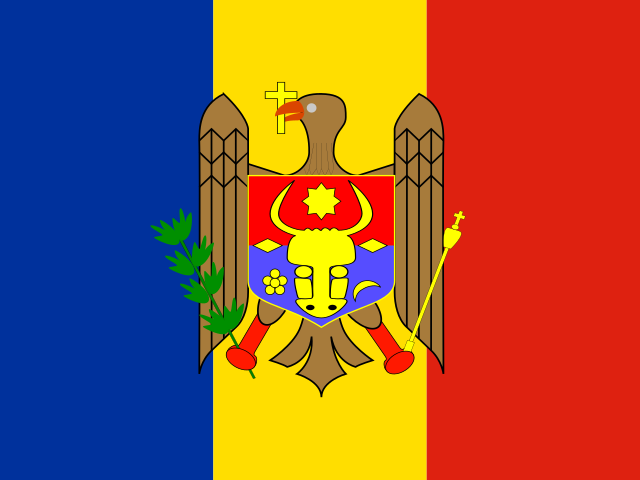
Region: Europe
Area: 33,850 km²
Population: 2,402,306
Libraries (Service Points): 2,543
Libraries in Republic of Moldova
According to statistical reports compiled by the National Librarianship Council (NLC) for the National Bureau of Statistics, the library system in Moldova consists of a total of 2,670 libraries, including 1,334 public and 1318 academic libraries (university, school, vocational schools etc.)
The library system employs a total of 4,193 librarians, including 2,369 public librarians.
Libraries funded from public funds are administered by the local public administrations.
The main strategic document for public libraries is the Strategy deconsolidation and modernization of territorial public libraries networks, 2017 – 2020. Its main goal is to strengthen and modernize the network of local public libraries in compliance with the needs of users and communities, digital era opportunities, strengthening the role of libraries in the community, encouraging effective partnerships, stimulating innovative practices and promoting lifelong learning. Besides, the document focuses modernization of territorial public libraries; development of the integrated information platform of public libraries; development of the continuous professional training system; and supporting the advocacy process for modern public libraries
Main Librarian’s Association’s objective are focused on sustaining the following areas: strengthening the role of librarians and libraries in society; involvement of the Association in the modernization and innovation of the library domain; increase institutional capacity of the Association and promote good managerial practices; development of the Association membership network and their loyalty; supporting professional formation and development and adapting to modern requirements; strengthening advocacy, lobbying and fundraising.
A seven-year national Novateca program, supported by the Bill & Melinda Gates Foundation in partnership with USAID, was started in 2012 to provide Moldovan citizens with access to relevant information and locally tailored services in public libraries countrywide.
Novateca is a network of more than 1,000 public libraries in each of Moldova’s 35 administrative regions, providing the public with 21st-century technology tools, digital literacy learning resources, and community services that address local needs. More than 450,000 library visitors have learned general internet skills and 260,000 have used Novateca library resources to access government information and services online.
Library data (Totals)
|
Library type |
Total |
National |
Academic |
Public |
Community |
School |
Other |
|---|---|---|---|---|---|---|---|
|
Libraries (Service Points)
Library service point is a fixed or mobile facility through which library provides a service to its users. Central libraries, branch libraries, mobile libraries, and external service points located in different geographical locations and managed by one administrative unit are all each individual service points. Number of libraries is the total number of central/main libraries, branch libraries, external service points and mobile libraries. 2,543 |
2,543 2024 |
6 2024 |
17 2024 |
1,283 2024 |
N/A 2024 |
1,147 2024 |
90 2024 |
|
Main Libraries
Central/main library is usually part or those parts of an administrative unit where the main administrative functions and the important parts of the library collection and services are located. An administrative unit comprising several branch libraries does not necessarily include a central library. 2 |
2 2024 |
2 2024 |
— |
— |
N/A 2024 |
— |
— |
|
Branch Libraries
Branch library is a part of a larger administrative unit providing, in separate quarters, a service for a particular user group (e.g. children, faculties) or for a locally defined clientele. Institute, departmental and other affiliated libraries are included. Mobile libraries and external service points are excluded. 2 |
2 2024 |
2 2024 |
— |
— |
N/A 2024 |
— |
— |
|
External Service Points
External service point is a point away from library premises at which a certain service is regularly offered to users. This includes places within a locality at which library material is deposited for informal circulation to a restricted group of users but without other library services, for example, old people’s homes, community centres, collections for hospital patients. Mobile libraries and their stops are not counted as external service points. — |
— |
— |
— |
— |
N/A 2024 |
— |
— |
|
Mobile Libraries
Mobile library is a library, sometimes a division of a public library, using transport means to provide documents and services directly to users as an alternative to access on library premises. 1 |
1 2024 |
1 2024 |
— |
— |
N/A 2024 |
— |
— |
|
Libraries (Administrative Units)
Administrative unit is any independent library, or group of libraries, under a single directorate or a single administration. The term “independent” does not imply legal or financial independence but only that the library is a recognisably separate unit, typically within a larger organisation. The administrative unit can be a single library or a larger organisation, typically containing a central/main library, branch libraries and administrative functions. 2,539 |
2,539 2024 |
2 2024 |
17 2024 |
1,283 2024 |
N/A 2024 |
1,147 2024 |
90 2024 |
|
Libraries with Internet Access
Libraries (Service Points) that provides internet access from at least one workstation available to the public regardless of whether access is free, and/or provides a wireless network allowing users to connect to the Internet. 2,023 |
2,023 2024 |
2 2024 |
17 2024 |
1,084 2024 |
N/A 2024 |
840 2024 |
80 2024 |
|
Full-Time Staff
Full-time equivalent (FTE) staff are all library employees who work for the library in return for payment. It includes professional staff, qualified staff, project staff and assistants. Other staff (library employees who work in security and on domestic duties, for example, cleaners, porters, caretakers and catering staff) and volunteers are excluded. 3,112 |
3,112 2024 |
190 2024 |
235 2024 |
1,779 2024 |
N/A 2024 |
753 2024 |
155 2024 |
|
Volunteers
Volunteer is a person working on library tasks without payment. In counting volunteers, the concept of headcount is used. 8,794 |
8,794 2024 |
20 2024 |
45 2024 |
4,231 2024 |
N/A 2024 |
4,246 2024 |
252 2024 |
|
Registered Users
Registered user is a person or organisation registered with a library in order to use its collection and/or services within or away from the library. Users may be registered upon their request or automatically when enrolling in the institutions. 1.1 M |
1,141,077 2024 |
17,036 2024 |
63,051 2024 |
646,411 2024 |
N/A 2024 |
360,390 2024 |
54,189 2024 |
|
Physical Visits
Physical visit is a person (individual) entering the library premises. 10.5 M |
10,451,129 2024 |
158,686 2024 |
458,002 2024 |
5,393,603 2024 |
N/A 2024 |
3,801,532 2024 |
639,306 2024 |
|
Physical Loans
Physical loan is a direct lending or delivery transaction of an item in physical form. Physical loans include loans of items in non-electronic form (e.g. books) and loans electronic documents on a physical carrier (e.g. CD-ROM). 16.9 M |
16,858,481 2024 |
484,000 2024 |
911,733 2024 |
7,666,329 2024 |
N/A 2024 |
6,309,241 2024 |
1,487,178 2024 |
|
eBook Loans
eBook is a non-serial digital document, licenced or not, where searchable text is prevalent, and similar to a print book (monograph). eBooks can be lent to users either on portable devices (eBook readers) or by transmitting the contents to the user’s PC or other device for a limited time period. 64,972 |
64,972 2024 |
969 2024 |
18,459 2024 |
38,800 2024 |
N/A 2024 |
3,514 2024 |
3,230 2024 |
|
Audio Book Loans
Audio book (or talking book) is a sound recording of readings of a book, magazine, or newspaper, usually designed for use by visually impaired people. Audio books can be lent to users either on a physical carrier or other device, or by transmitting the content to the user’s PC or other device for a limited time period. — |
— |
— |
— |
— |
N/A 2024 |
— |
— |
|
Downloads
Download is a content unit that is successfully requested from a library-provided online service or other internet service (e.g. database, electronic serial or digital document). 56,048 |
56,048 2024 |
85 2017 |
22,685 2017 |
4,355 2017 |
N/A 2024 |
28,923 2018 |
— |
Library data (Per 1M People)
|
Library type |
Total |
National |
Academic |
Public |
Community |
School |
Other |
|---|---|---|---|---|---|---|---|
|
Libraries (Service Points)
2,543
Library service point is a fixed or mobile facility through which library provides a service to its users. Central libraries, branch libraries, mobile libraries, and external service points located in different geographical locations and managed by one administrative unit are all each individual service points. Number of libraries is the total number of central/main libraries, branch libraries, external service points and mobile libraries. |
1,058.6 2024 |
2.5 2024 |
7.1 2024 |
534.1 2024 |
— 2024 |
477.5 2024 |
37.5 2024 |
|
Main Libraries
2
Central/main library is usually part or those parts of an administrative unit where the main administrative functions and the important parts of the library collection and services are located. An administrative unit comprising several branch libraries does not necessarily include a central library. |
0.8 2024 |
0.8 2024 |
— |
— |
— 2024 |
— |
— |
|
Branch Libraries
2
Branch library is a part of a larger administrative unit providing, in separate quarters, a service for a particular user group (e.g. children, faculties) or for a locally defined clientele. Institute, departmental and other affiliated libraries are included. Mobile libraries and external service points are excluded. |
0.8 2024 |
0.8 2024 |
— |
— |
— 2024 |
— |
— |
|
External Service Points
—
External service point is a point away from library premises at which a certain service is regularly offered to users. This includes places within a locality at which library material is deposited for informal circulation to a restricted group of users but without other library services, for example, old people’s homes, community centres, collections for hospital patients. Mobile libraries and their stops are not counted as external service points. |
— |
— |
— |
— |
— 2024 |
— |
— |
|
Mobile Libraries
1
Mobile library is a library, sometimes a division of a public library, using transport means to provide documents and services directly to users as an alternative to access on library premises. |
0.4 2024 |
0.4 2024 |
— |
— |
— 2024 |
— |
— |
|
Libraries (Administrative Units)
2,539
Administrative unit is any independent library, or group of libraries, under a single directorate or a single administration. The term “independent” does not imply legal or financial independence but only that the library is a recognisably separate unit, typically within a larger organisation. The administrative unit can be a single library or a larger organisation, typically containing a central/main library, branch libraries and administrative functions. |
1,056.9 2024 |
0.8 2024 |
7.1 2024 |
534.1 2024 |
— 2024 |
477.5 2024 |
37.5 2024 |
|
Libraries with Internet Access
2,023
Libraries (Service Points) that provides internet access from at least one workstation available to the public regardless of whether access is free, and/or provides a wireless network allowing users to connect to the Internet. |
842.1 2024 |
0.8 2024 |
7.1 2024 |
451.2 2024 |
— 2024 |
349.7 2024 |
33.3 2024 |
|
Full-Time Staff
3,112
Full-time equivalent (FTE) staff are all library employees who work for the library in return for payment. It includes professional staff, qualified staff, project staff and assistants. Other staff (library employees who work in security and on domestic duties, for example, cleaners, porters, caretakers and catering staff) and volunteers are excluded. |
1,295.4 2024 |
79.1 2024 |
97.8 2024 |
740.5 2024 |
— 2024 |
313.4 2024 |
64.5 2024 |
|
Volunteers
8,794
Volunteer is a person working on library tasks without payment. In counting volunteers, the concept of headcount is used. |
3,660.6 2024 |
8.3 2024 |
18.7 2024 |
1,761.2 2024 |
— 2024 |
1,767.5 2024 |
104.9 2024 |
|
Registered Users
1.1 M
Registered user is a person or organisation registered with a library in order to use its collection and/or services within or away from the library. Users may be registered upon their request or automatically when enrolling in the institutions. |
474,992.4 2024 |
7,091.5 2024 |
26,246 2024 |
269,079.4 2024 |
— 2024 |
150,018.4 2024 |
22,557.1 2024 |
|
Physical Visits
10.5 M
Physical visit is a person (individual) entering the library premises. |
4.4 M 2024 |
66,055.7 2024 |
190,651 2024 |
2.2 M 2024 |
— 2024 |
1.6 M 2024 |
266,121.8 2024 |
|
Physical Loans
16.9 M
Physical loan is a direct lending or delivery transaction of an item in physical form. Physical loans include loans of items in non-electronic form (e.g. books) and loans electronic documents on a physical carrier (e.g. CD-ROM). |
7 M 2024 |
201,473.1 2024 |
379,524.1 2024 |
3.2 M 2024 |
— 2024 |
2.6 M 2024 |
619,062.7 2024 |
|
eBook Loans
64,972
eBook is a non-serial digital document, licenced or not, where searchable text is prevalent, and similar to a print book (monograph). eBooks can be lent to users either on portable devices (eBook readers) or by transmitting the contents to the user’s PC or other device for a limited time period. |
27,045.7 2024 |
403.4 2024 |
7,683.9 2024 |
16,151.1 2024 |
— 2024 |
1,462.8 2024 |
1,344.5 2024 |
|
Audio Book Loans
—
Audio book (or talking book) is a sound recording of readings of a book, magazine, or newspaper, usually designed for use by visually impaired people. Audio books can be lent to users either on a physical carrier or other device, or by transmitting the content to the user’s PC or other device for a limited time period. |
— |
— |
— |
— |
— 2024 |
— |
— |
|
Downloads
56,048
Download is a content unit that is successfully requested from a library-provided online service or other internet service (e.g. database, electronic serial or digital document). |
23,330.9 2024 |
35.4 2017 |
9,443 2017 |
1,812.8 2017 |
— 2024 |
12,039.7 2018 |
— |
Contextual data
|
Population |
Republic of Moldova |
Region |
World |
|---|---|---|---|
|
Population Total population is based on the de facto definition of population, which counts all residents regardless of legal status or citizenship. The values shown are midyear estimates. |
2,402,306 2024 |
928,263,208 2024 |
8,141,808,945 2024 |
|
Proportion of Population Younger than 15 Age dependency ratio, young, is the ratio of younger dependents--people younger than 15--to the working-age population--those ages 15-64. Data are shown as the proportion of dependents per 100 working-age population. |
30.9% 2024 |
27.0% 2024 |
38.0% 2024 |
|
Proportion of Population Older than 64 Age dependency ratio, old, is the ratio of older dependents--people older than 64--to the working-age population--those ages 15-64. Data are shown as the proportion of dependents per 100 working-age population. |
25.3% 2024 |
28.1% 2024 |
15.7% 2024 |
|
Population Growth Annual population growth rate for year t is the exponential rate of growth of midyear population from year t-1 to t, expressed as a percentage. Population is based on the de facto definition of population, which counts all residents regardless of legal status or citizenship. |
-2.3% 2024 |
0 2024 |
1.0% 2024 |
|
Population Density Population density is midyear population divided by land area in square kilometers. Population is based on the de facto definition of population, which counts all residents regardless of legal status or citizenship--except for refugees not permanently settled in the country of asylum, who are generally considered part of the population of their country of origin. Land area is a country's total area, excluding area under inland water bodies, national claims to continental shelf, and exclusive economic zones. In most cases the definition of inland water bodies includes major rivers and lakes. |
85.4% 2023 |
33.7% 2022 |
61.6% 2022 |
|
Urban Population Urban population refers to people living in urban areas as defined by national statistical offices. The data are collected and smoothed by United Nations Population Division. |
43.5% 2024 |
74.0% 2024 |
57.6% 2024 |
|
Information Infrastructure |
Republic of Moldova |
Region |
World |
|---|---|---|---|
|
Internet Users Internet users are individuals who have used the Internet (from any location) in the last 3 months. The Internet can be used via a computer, mobile phone, personal digital assistant, games machine, digital TV etc. |
80.2% 2023 |
90.9% 2024 |
71.2% 2024 |
|
Female Internet Users This indicator refers to female individuals who have used the Internet (from any location) in the last 3 months. The Internet can be used via a computer, mobile phone, personal digital assistant, games machine, digital TV etc. |
- |
90.0% 2024 |
68.2% 2024 |
|
Male Internet Users This indicator refers to male individuals who have used the Internet (from any location) in the last 3 months. The Internet can be used via a computer, mobile phone, personal digital assistant, games machine, digital TV etc. |
- |
90.0% |
- |
|
Access to Electricity Access to electricity is the percentage of population with access to electricity. Electrification data are collected from industry, national surveys and international sources. |
100.0% 2023 |
100.0% 2023 |
91.6% 2023 |
|
Economy, Poverty, and Employment |
Republic of Moldova |
Region |
World |
|---|---|---|---|
|
GDP per Capita This indicator provides values for gross domestic product (GDP) expressed in current international dollars, converted by purchasing power parities (PPPs). PPPs account for the different price levels across countries and thus PPP-based comparisons of economic output are more appropriate for comparing the output of economies and the average material well-being of their inhabitants than exchange-rate based comparisons. Gross domestic product is the total income earned through the production of goods and services in an economic territory during an accounting period. It can be measured in three different ways: using either the expenditure approach, the income approach, or the production approach. This series has been linked to produce a consistent time series to counteract breaks in series over time due to changes in base years, source data and methodologies. Thus, it may not be comparable with other national accounts series in the database for historical years. The core indicator has been divided by the general population to achieve a per capita estimate. This indicator is expressed in current prices, meaning no adjustment has been made to account for price changes over time. The PPP conversion factor is a currency conversion factor and a spatial price deflator. PPPs convert different currencies to a common currency and, in the process of conversion, equalize their purchasing power by eliminating the differences in price levels between countries, thereby allowing volume or output comparisons of GDP and its expenditure components. |
18,615 2024 |
51,720.6 2024 |
24,405 2024 |
|
Poverty Rate Poverty headcount ratio at $3.00 a day is the percentage of the population living on less than $3.00 a day at 2021 purchasing power adjusted prices. As a result of revisions in PPP exchange rates, poverty rates for individual countries cannot be compared with poverty rates reported in earlier editions. |
0.1% 2023 |
0.5% 2024 |
10.3% 2024 |
|
Inequality Gini index measures the extent to which the distribution of income (or, in some cases, consumption expenditure) among individuals or households within an economy deviates from a perfectly equal distribution. A Lorenz curve plots the cumulative percentages of total income received against the cumulative number of recipients, starting with the poorest individual or household. The Gini index measures the area between the Lorenz curve and a hypothetical line of absolute equality, expressed as a percentage of the maximum area under the line. Thus a Gini index of 0 represents perfect equality, while an index of 100 implies perfect inequality. |
26.8% 2023 |
0.0% |
- |
|
Unemployment Unemployment refers to the share of the labor force that is without work but available for and seeking employment. Definitions of labor force and unemployment differ by country. |
1.4% 2024 |
5.3% 2024 |
6.2% 2021 |
|
Inactive Youth The share of youth not in education, employment or training (also known as “the NEET rate”) conveys the number of young persons not in education, employment or training as a percentage of the total youth population. Youth not in education are those who were neither enrolled in school nor in a formal training program (e.g. vocational training). For the purposes of this indicator, youth is defined as all persons between the ages of 15 and 24 (inclusive). percentage of youth population |
11.5% 2024 |
11.7% 2024 |
- |
|
Education and Literacy |
Republic of Moldova |
Region |
World |
|---|---|---|---|
|
Education Spending General government expenditure on education (current, capital, and transfers) is expressed as a percentage of GDP. It includes expenditure funded by transfers from international sources to government. General government usually refers to local, regional and central governments. percentage of GDP |
6.6% 2023 |
4.6% 2022 |
3.5% 2023 |
|
Adult Literacy Rate Adult literacy rate is the percentage of people ages 15 and above who can both read and write with understanding a short simple statement about their everyday life. percentage of people ages 15 and above |
99.4% 2014 |
4.6% 2022 |
87.7% 2024 |
|
Female Adult Literacy Adult literacy rate is the percentage of people ages 15 and above who can both read and write with understanding a short simple statement about their everyday life. percentage of females ages 15 and above |
99.1% 2014 |
98.5% 2024 |
84.6% 2024 |
|
Male Adult Literacy Adult literacy rate is the percentage of people ages 15 and above who can both read and write with understanding a short simple statement about their everyday life. percentage of males ages 15 and above |
99.1% 2014 |
99.1% 2023 |
90.9% 2024 |
|
Female Youth Literacy Youth literacy rate is the percentage of people ages 15-24 who can both read and write with understanding a short simple statement about their everyday life. percentage of females ages 15-24 |
99.8% 2014 |
99.8% 2023 |
92.0% 2024 |
|
Male Youth Literacy Youth literacy rate is the percentage of people ages 15-24 who can both read and write with understanding a short simple statement about their everyday life. percentage of males ages 15-24 |
99.8% 2014 |
99.8% 2023 |
94.1% 2024 |
|
Research and Innovation |
Republic of Moldova |
Region |
World |
|---|---|---|---|
|
Research Spending Gross domestic expenditures on research and development (R&D), expressed as a percent of GDP. They include both capital and current expenditures in the four main sectors: Business enterprise, Government, Higher education and Private non-profit. R&D covers basic research, applied research, and experimental development. percentage of GDP |
0.2% 2023 |
2.0% 2022 |
2.7% 2022 |
|
Researchers The number of researchers engaged in Research &Development (R&D), expressed as per million. Researchers are professionals who conduct research and improve or develop concepts, theories, models techniques instrumentation, software of operational methods. R&D covers basic research, applied research, and experimental development. per million people |
717 2023 |
3,466.1 2022 |
1,516 2018 |
|
Scientific Articles Article counts refer to publications from a selection of conference proceedings and peer-reviewed journals from Scopus in science and engineering fields, according to the National Center for Science and Engineering Statistics Taxonomy of Disciplines. fractional count |
284 2022 |
913,901.4 2022 |
3,338,192 2022 |
National Library Associations
Librarians’ Association of Moldova (LAM) / Asociatia Bibliotecarilor din Moldova
The Association is the only professional organization of librarians in Moldova, aiming to bring together librarians and community members to a form of association. Currently LAM has over 2,220 individual members, that represents 48% of Moldovan librarians. Major priorities are focused on strengthening the role of librarians and libraries in society; involvement of LAM in the innovation of the library domain; increasing institutional capacity of LAM; development of the LAM membership network; supporting professional development; strengthening advocacy. Main activities in the past 5 years were based on professional development, by launching 3 curricula and facilitating trainings.
National Library
The National Library of Moldova / Biblioteca Nationala din Republica Moldova
The National Library ensures the safeguarding of library materials published in the country and constitutes a collection of valuable documents, develops, preserves the legal deposit of documents; performs the function of center of expertise and methodological assistance in the field of preservation and restoration as well as participates in carrying out the national bibliographic control. The National Library has the status of a national library center which: perform the coordination and correlation function in the field of research and development of libary science, and collects and aggregates statistical data presented by librarians.
Policy Making Institutions
The Ministry of Education, Culture and Research / Ministerul Educa?iei, Culturii ?i Cercet?rii
The Ministry is the body that coordinates the educational system in the Republic of Moldova, sets the objectives of the educational system as a whole, and the objectives of education by levels and educational profiles; which develops and ensures the implementation of strategies and policies in the fields of culture, art, cults, cinema and audiovisual.
According to the Law on Libraries the Ministry:
- Coordinates and promotes state policy in the field of libraries;
- Ensures the national unity in the activity of libraries;
- Coordinates and monitors the activity of the national libraries system;
- Elaborates and approves the normative framework regarding the activity of the public libraries;
- Monitors the process of implementing legislation in the field of libraries’ activity;
- Maintains data statistics on the organization and functioning of public libraries;
- Organizes and carries out the attestation of the specialized personnel of the libraries.
Library Support Organisations
The National Librarianship Council (NLC) / Consiliul Biblioteconomic National
The National Librarianship Council (NLC) is an advisory body of the he Ministry of Education, Culture and Research of the Republic of Moldova, which contributes to the elaboration of regulatory acts in the field of libraries, ensures the national unity in librarianship, carries out actions to coordinate and co-operate the activities of institutions in the national libraries system.
National Policy for Libraries
The Strategy of Consolidating and Modernizing the Network of Territorial Public Libraries: 2017-2020 / Strategia de consolidare și modernizare a rețelei bibliotecilor publice teritoriale 2017-2020
The Strategy envisons to strengthen and modernize the network of local public libraries in meeting the needs of users and communities, the opportunities of the digital age, strengthening the role of public libraries in the community, encouraging effective partnerships, stimulating innovative practices and promoting life long learning.
Library Law
The law on libraries / Legea cu privire la biblioteci
The purpose of the law is to strengthen the role of the library in modern society through its development as a public service to ensure access to reading and development of interest in information, learning, education and research, cultural activities, and through enhancing the capacity of library involvement in the transfer of knowledge and free education opinions.
Legal Deposit Law
Law on editorial activity / Legea cu privire la activitatea editorială
Purpose of the Law is meeting the needs of personality, society, state in editorial production; creating opportunities for affirmation of citizens as authors, regardless of race, nationality, ethnic origin, language, religion, gender, opinion, political affiliation, wealth or social origin; ensuring the right to freedom of thought and speech, to free expression of opinions and beliefs; contributing to the national-cultural development of the people through the considerable increase in circulation and volume of editions, by the thematic expansion of book production; raising the level of culture of citizens by ensuring access to editorial production, familiarization with general human values, editing in original or translation of the most valuable works of national and universal literature; establishing relationships with publishers in other countries and concluding international conventions and agreements in the editorial field; increasing the number of national book editions in the languages of wide circulation in order to promote the image of the Republic of Moldova in the world; strengthening and modernizing the technical-material basis of publishing houses, printers and broadcasting broadcasting networks.
The libraries are responsable for ensuring the protection of the written heritage of the country, keeping it permanently and preserving it. The legal deposit includes: books, serials, periodicals (magazines, newspapers, almanacs, calendars, newsletters, official acts issued by the central and local public administration authorities, parties, non-governmental organizations, musical scores, albums, stamps, paintings, portraits, engravings, illustrations, illustrated postcards, photographs reproduced in series, atlases, maps, printed plans, posters, teaching globes, material of political, administrative, cultural, artistic, scientific, educational, religious, sports, PhD thesis, multimedia editions, materials printed in Braille and “talking books”, sound and video recordings (discs, audio and video cassettes, diafilms, slides, microfilms, microfiches), electronic documents – software data files, published on magnetic, optical or any other medium designed to be processed in the computer (CDs, CDs, DVDs), standards, patents and innovations, technical and operating rules, industrial and company catalogs, advertising and advertising materials, any other documents printed or published by graphic or physico-chemical procedures (lithography, photography, photocopying, phono and videography). Only the National Library, holds the copy of the LD, that can be borrowed by the library users.
Copyright Law & Library Exceptions and Limitations
Law on Copyright and Related Rights / Legea privind dreptul de autor şi drepturile conexe
The law regulates the relationships that arise in the creation and exploitation of literary, artistic and scientific works (copyright), interpretations, phonograms, videograms and broadcasts of broadcasting organizations (related rights), as well as other rights which are recognized in connection with the intellectual activity of the field of literature, art and science.
Professional Qualification Requirements
Professional Qualification Requirements
The Law on Libraries admits that the employment of the deputy director and deputy director of the public library shall be carried out by contest, based on the criteria of professional and managerial competence. In order to appreciate the activity, the level of professional knowledge and skills, as well as in order to stimulate the improvement of the professional skills and to increase the efficiency of the activity, the personnel in the public libraries are subject to attestation every 5 years. The certification of public library specialists is carried out by the Ministry of Education, Culture and Research jointly with other central and local public authorities, which have subordinated libraries, under a regulation approved by the Ministry of Education, Culture and Research.
Education
Education
The State University of Moldova provides studies in Librarianship, Information and Archiving. During past five decades the school has undergone a series of changes, reflected in its change of name: from the School of Librarianship and Bibliography, to the School of Library Science and Information Assistance, to its present inclusion in the Department of Communications. Currently, the following specializations are included in the bachelor’s degree program: librarianship, information assistance, and archives; IT and communications; and information and sociocultural services. Master’s degree studies offer specializations in digital libraries and information services, and the management of information institutions. The MSU program focuses on developing competencies in cataloging, data analysis, communications, information literacy, needs assessment, and the use of the internet and other ICTs. The master’s-level programs are of two types: research-based and professional-based.
Professional Publications
Journal of Bibliology / Magazin bibliologic
Published twice a year, Journal of Bibliology is a professional journal edited by the National Library. It aims to update the knowledge, promote the trends of the field, promote the advanced national and international experiences.
BiblioPolis
Professional magazine, published four times a year by the Municipal Library “B.P. Hasdeu”, aims to update the knowledge, promote the trends of the field, promote the advanced national and international experiences.
Professional Events
The day of librarians
Organised by the Librarians’ Association of Moldova, the event takes place on the 23 of April each year. It aims to promote the role of libraries in commnunities. All libraries are invitated to participate wih open public events that invited public to take part. As well library community participates at open forum to discuss with central authorities on main library issues.
Bibliological Symposium
Every year in March, the National Libary from Moldova invites library community to participate in this event to discuss previous year’s achievements.
Forums of Managers from the National Library System
The Library Trainers Forum is held every year in September. Participants are library trainers and managers who come together to discuss about challanges and achievements in the area of training delivered by libraries to public.
Library Location Resources