Tunisia faces not only a relatively high illiteracy rate of 19.1%, but also a large number of early school leavers – up to 120 000 in 2014 according the National Institute of Statistics (2014). Connected to this is a high unemployment rate, standing at 22.79% and 12.55% for women and men respectively. Much of the problem of early school leaving is concentrated in rural areas of the country.
One such area is the island of Djerba in southern Tunisia. The Erriadh district, in the middle of the island, is home to 10 626 inhabitants according to 2014 census figures. While there are a number of small factories and shops, it faces similar challenges to other parts of the country, but is rich in civil institutions including a library and other cultural, educational and social organisations which work together for the benefit of all.
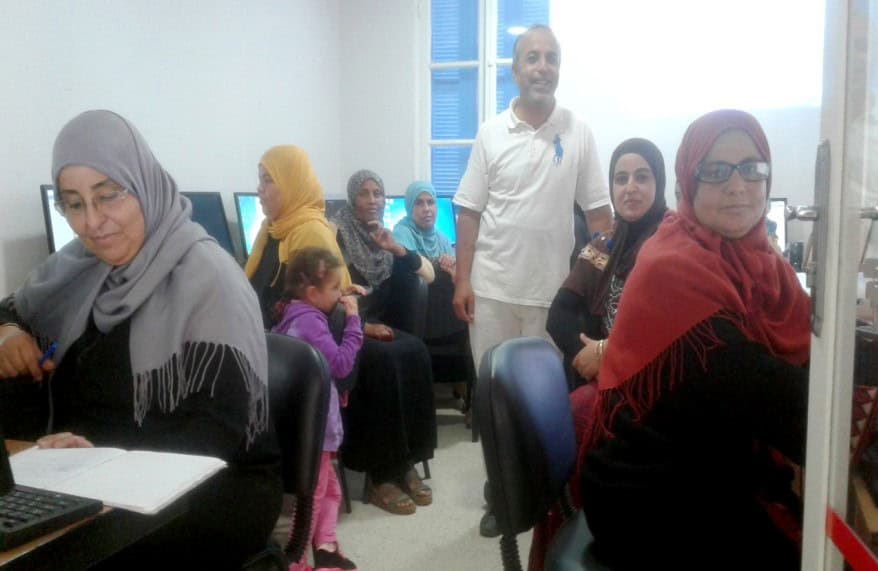
Given its commitment to sustainable development, the Erriadh Public Library has therefore sought to help primarily illiterate women develop digital skills by launching a computer literacy club.
This initiative aimed to give those who had left school without skills a second chance to build their ability to find work by giving them the knowledge and support to become computer literate. The course placed a particular emphasis on inclusive life-long learning, gender equality, and access to decent jobs and economic development.
There was a specific focus on building partnerships with like-minded organisations such as the National Union of Tunisian Women and the Djerba Solidarity and Development Association. The National Union of Tunisian Women, for example, offers training to unemployed women in different fields such as sewing and embroidery but also encourages them to take part in the computer literacy club offered by the library as it may greatly help them in their future careers.
A first group of 32 women therefore began their lessons in late 2017, with a second class running from July to November 2018. The curriculum is based around that already used in schools, using tools such as computers, scanners and spreadsheets. There is a strong focus on the practical rather than the theoretical. During the lessons, the participants learn about the basics of computing, how to use peripheral devices, exploitation systems, the internet, Microsoft Office and social media platforms.
As a result of the conducted lessons, the assessment at the end of the last training sessions showed that 90.62% of the participants passed the course with good grades. The marks were between 9 and 17 which is a relatively high result overall.
One of the most important achievements of our club is that participants have learnt to depend on themselves. For example, Mrs Najoua has been able to start contributing actively to her husband’s accountancy business. Mrs Ibtissem has created a social media account to market her work as a tailor. Other participants have been helped in numerous ways to improve their skills in other fields. Given the success rate of the initiative, the library has decided to create a group for male learners that will start classes at the end of December 2018.