

Libraries in Cuba
Cuba has a National Library and four centralized library systems: Public libraries, school libraries, university libraries and specialized libraries. The institution responsible for the development of library policies and legislation is the National Library of Cuba José Martí, which belongs to the Ministry of Culture of the Republic of Cuba and holds the documentary heritage of the nation.
Library funding depends on the organisations to which each system belongs. For example, public libraries are financed by local and provincial governments, school libraries by the Ministry of Education, university libraries by the Ministry of Higher Education and specialized libraries of the Ministry of Science, Technology and Environment (CITMA) and other institutions.
The priorities for the development of the Cuban library field are aimed at strengthening libraries, increasing the use of information and communication technologies in terms of information services to the community and the preservation of documentary heritage and historical memory.
Each library type has distinctive characteristics. The Public Libraries System is managed methodologically by the National Library of Cuba and are the only library institutions that serve the public – from children who are not school-aged to older adults. The public library sector is strong in its outreach efforts, to all corners of the country including hard-to-reach mountainous areas.
Public libraries provide services in prisons, to people with disabilities, in hospitals, in maternity homes, in schools and day care centres, in children’s homes without subsidiary protection, in workshops and work centres where they carry their collections with different extensionist modalities such as mini libraries, bookmobiles, houses libraries, reading rooms, travel boxes.
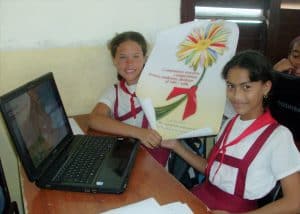
On the other hand, the School Library System works mainly as a support to education, although together with the Public Library System they support the National Program for Reading that exists in the country, whose fundamental task is the promotion of positive reading habits.
Among the most significant achievements of libraries in the country is the unity that exists between the library sectors, regardless of the type of libraries to which each belongs. They cooperate with each other in meeting the information needs of users and work together to uplift communities they serve.
The Cuban Association of Librarians brings together the librarians of the country and has among its main objectives the promotion and advocacy for the profession, and the achievement of a united library sector. Cuban libraries contribute to the Sustainable Development Goals of the UN 2030 Agenda and the National Development Plan and exemplify the positive role libraries play in helping communities face the challenges of the future.
Library data
Contextual data
Population
Population Growth
Proportion of Population Younger than 15
Proportion of Population Older than 64
Population Density
people per sq km
Population Growth
Access to Electricity
Internet Users
Female Internet Users
Male Internet Users
GDP per capita
Poverty Rate
2011 PPP
Inequality
2011 PPP
Unemployment
Inactive Youth
2011 PPP
Education Spending
% of GDP
Adult Literacy Rate
% of people age 15+
Female Adult Literacy
% of GDP
Male Adult Literacy
% of people age 15+
Female Youth Literacy
% of GDP
Male Youth Literacy
% of people age 15+
Research Spending
% of GDP
Researchers
% of GDP
Research Spending
% of GDP
Library data
|
Library type |
Total |
National |
Academic |
Public |
Community |
School |
Other |
|---|---|---|---|---|---|---|---|
|
Libraries (Service Points)
9,029
Library service point is a fixed or mobile facility through which library provides a service to its users. Central libraries, branch libraries, mobile libraries, and external service points located in different geographical locations and managed by one administrative unit are all each individual service points. Number of libraries is the total number of central/main libraries, branch libraries, external service points and mobile libraries. |
9,029 2024 |
1 2024 |
— |
386 2024 |
— |
7,999 2024 |
643 2024 |
|
Main Libraries
171
Central/main library is usually part or those parts of an administrative unit where the main administrative functions and the important parts of the library collection and services are located. An administrative unit comprising several branch libraries does not necessarily include a central library. |
171 2018 |
— |
— |
171 2018 |
— |
— |
— |
|
Branch Libraries
218
Branch library is a part of a larger administrative unit providing, in separate quarters, a service for a particular user group (e.g. children, faculties) or for a locally defined clientele. Institute, departmental and other affiliated libraries are included. Mobile libraries and external service points are excluded. |
218 2018 |
— |
— |
218 2018 |
— |
— |
— |
|
External Service Points
155
External service point is a point away from library premises at which a certain service is regularly offered to users. This includes places within a locality at which library material is deposited for informal circulation to a restricted group of users but without other library services, for example, old people’s homes, community centres, collections for hospital patients. Mobile libraries and their stops are not counted as external service points. |
155 2018 |
— |
— |
155 2018 |
— |
— |
— |
|
Mobile Libraries
2
Mobile library is a library, sometimes a division of a public library, using transport means to provide documents and services directly to users as an alternative to access on library premises. |
2 2018 |
— |
— |
2 2018 |
— |
— |
— |
|
Libraries (Administrative Units)
390
Administrative unit is any independent library, or group of libraries, under a single directorate or a single administration. The term “independent” does not imply legal or financial independence but only that the library is a recognisably separate unit, typically within a larger organisation. The administrative unit can be a single library or a larger organisation, typically containing a central/main library, branch libraries and administrative functions. |
390 2024 |
1 2024 |
— |
389 2018 |
— |
— |
— |
|
Libraries with Internet Access
724
Libraries (Service Points) that provides internet access from at least one workstation available to the public regardless of whether access is free, and/or provides a wireless network allowing users to connect to the Internet. |
724 2024 |
1 2024 |
— |
15 2024 |
— |
150 2024 |
558 2024 |
|
Full-Time Staff
13,482
Full-time equivalent (FTE) staff are all library employees who work for the library in return for payment. It includes professional staff, qualified staff, project staff and assistants. Other staff (library employees who work in security and on domestic duties, for example, cleaners, porters, caretakers and catering staff) and volunteers are excluded. |
13,482 2024 |
163 2024 |
— |
3,042 2024 |
— |
9,124 2024 |
1,153 2024 |
|
Volunteers
—
Volunteer is a person working on library tasks without payment. In counting volunteers, the concept of headcount is used. |
— |
— |
— |
— |
— |
— |
— |
|
Registered Users
2.1 M
Registered user is a person or organisation registered with a library in order to use its collection and/or services within or away from the library. Users may be registered upon their request or automatically when enrolling in the institutions. |
2,111,953 2024 |
1,278 2024 |
— |
210,922 2024 |
— |
997,224 2024 |
902,529 2024 |
|
Physical Visits
6 M
Physical visit is a person (individual) entering the library premises. |
5,970,173 2024 |
49,899 2024 |
— |
4,913,549 2024 |
— |
935,290 2024 |
71,435 2024 |
|
Physical Loans
5.6 M
Physical loan is a direct lending or delivery transaction of an item in physical form. Physical loans include loans of items in non-electronic form (e.g. books) and loans electronic documents on a physical carrier (e.g. CD-ROM). |
5,580,577 2024 |
54,965 2024 |
— |
3,944,092 2024 |
— |
1,537,639 2024 |
43,881 2024 |
|
eBook Loans
3,496
eBook is a non-serial digital document, licenced or not, where searchable text is prevalent, and similar to a print book (monograph). eBooks can be lent to users either on portable devices (eBook readers) or by transmitting the contents to the user’s PC or other device for a limited time period. |
3,496 2024 |
1,998 2024 |
— |
1,498 2024 |
— |
— |
— |
|
Audio Book Loans
2,617
Audio book (or talking book) is a sound recording of readings of a book, magazine, or newspaper, usually designed for use by visually impaired people. Audio books can be lent to users either on a physical carrier or other device, or by transmitting the content to the user’s PC or other device for a limited time period. |
2,617 2024 |
876 2024 |
— |
1,098 2024 |
— |
643 2021 |
— |
|
Downloads
220,462
Download is a content unit that is successfully requested from a library-provided online service or other internet service (e.g. database, electronic serial or digital document). |
220,462 2024 |
1,265 2024 |
— |
219,197 2024 |
— |
— |
— |
Contextual data
|
Population |
Cuba |
Region |
World |
|---|---|---|---|
|
Population Total population is based on the de facto definition of population, which counts all residents regardless of legal status or citizenship. The values shown are midyear estimates. |
10,979,783 2024 |
662,186,388 2024 |
8,141,808,945 2024 |
|
Proportion of Population Younger than 15 Age dependency ratio, young, is the ratio of younger dependents--people younger than 15--to the working-age population--those ages 15-64. Data are shown as the proportion of dependents per 100 working-age population. |
22.4% 2024 |
33.3% 2024 |
38.0% 2024 |
|
Proportion of Population Older than 64 Age dependency ratio, old, is the ratio of older dependents--people older than 64--to the working-age population--those ages 15-64. Data are shown as the proportion of dependents per 100 working-age population. |
24.3% 2024 |
14.5% 2024 |
15.7% 2024 |
|
Population Growth Annual population growth rate for year t is the exponential rate of growth of midyear population from year t-1 to t, expressed as a percentage. Population is based on the de facto definition of population, which counts all residents regardless of legal status or citizenship. |
-0.4% 2024 |
1 2024 |
1.0% 2024 |
|
Population Density Population density is midyear population divided by land area in square kilometers. Population is based on the de facto definition of population, which counts all residents regardless of legal status or citizenship--except for refugees not permanently settled in the country of asylum, who are generally considered part of the population of their country of origin. Land area is a country's total area, excluding area under inland water bodies, national claims to continental shelf, and exclusive economic zones. In most cases the definition of inland water bodies includes major rivers and lakes. |
106.2% 2023 |
32.6% 2022 |
61.6% 2022 |
|
Urban Population Urban population refers to people living in urban areas as defined by national statistical offices. The data are collected and smoothed by United Nations Population Division. |
77.2% 2024 |
81.3% 2024 |
57.6% 2024 |
|
Information Infrastructure |
Cuba |
Region |
World |
|---|---|---|---|
|
Internet Users Internet users are individuals who have used the Internet (from any location) in the last 3 months. The Internet can be used via a computer, mobile phone, personal digital assistant, games machine, digital TV etc. |
71.3% 2023 |
81.7% 2024 |
71.2% 2024 |
|
Female Internet Users This indicator refers to female individuals who have used the Internet (from any location) in the last 3 months. The Internet can be used via a computer, mobile phone, personal digital assistant, games machine, digital TV etc. |
75.1% 2019 |
81.3% 2024 |
68.2% 2024 |
|
Male Internet Users This indicator refers to male individuals who have used the Internet (from any location) in the last 3 months. The Internet can be used via a computer, mobile phone, personal digital assistant, games machine, digital TV etc. |
- |
81.3% |
- |
|
Access to Electricity Access to electricity is the percentage of population with access to electricity. Electrification data are collected from industry, national surveys and international sources. |
100.0% 2023 |
98.4% 2023 |
91.6% 2023 |
|
Economy, Poverty, and Employment |
Cuba |
Region |
World |
|---|---|---|---|
|
GDP per Capita This indicator provides values for gross domestic product (GDP) expressed in current international dollars, converted by purchasing power parities (PPPs). PPPs account for the different price levels across countries and thus PPP-based comparisons of economic output are more appropriate for comparing the output of economies and the average material well-being of their inhabitants than exchange-rate based comparisons. Gross domestic product is the total income earned through the production of goods and services in an economic territory during an accounting period. It can be measured in three different ways: using either the expenditure approach, the income approach, or the production approach. This series has been linked to produce a consistent time series to counteract breaks in series over time due to changes in base years, source data and methodologies. Thus, it may not be comparable with other national accounts series in the database for historical years. The core indicator has been divided by the general population to achieve a per capita estimate. This indicator is expressed in current prices, meaning no adjustment has been made to account for price changes over time. The PPP conversion factor is a currency conversion factor and a spatial price deflator. PPPs convert different currencies to a common currency and, in the process of conversion, equalize their purchasing power by eliminating the differences in price levels between countries, thereby allowing volume or output comparisons of GDP and its expenditure components. |
- |
22,880.9 2024 |
24,405 2024 |
|
Poverty Rate Poverty headcount ratio at $3.00 a day is the percentage of the population living on less than $3.00 a day at 2021 purchasing power adjusted prices. As a result of revisions in PPP exchange rates, poverty rates for individual countries cannot be compared with poverty rates reported in earlier editions. |
- |
4.5% 2024 |
10.3% 2024 |
|
Inequality Gini index measures the extent to which the distribution of income (or, in some cases, consumption expenditure) among individuals or households within an economy deviates from a perfectly equal distribution. A Lorenz curve plots the cumulative percentages of total income received against the cumulative number of recipients, starting with the poorest individual or household. The Gini index measures the area between the Lorenz curve and a hypothetical line of absolute equality, expressed as a percentage of the maximum area under the line. Thus a Gini index of 0 represents perfect equality, while an index of 100 implies perfect inequality. |
- |
0.0% |
- |
|
Unemployment Unemployment refers to the share of the labor force that is without work but available for and seeking employment. Definitions of labor force and unemployment differ by country. |
1.7% 2018 |
5.5% 2024 |
6.2% 2021 |
|
Inactive Youth The share of youth not in education, employment or training (also known as “the NEET rate”) conveys the number of young persons not in education, employment or training as a percentage of the total youth population. Youth not in education are those who were neither enrolled in school nor in a formal training program (e.g. vocational training). For the purposes of this indicator, youth is defined as all persons between the ages of 15 and 24 (inclusive). percentage of youth population |
- |
18.4% 2024 |
- |
|
Education and Literacy |
Cuba |
Region |
World |
|---|---|---|---|
|
Education Spending General government expenditure on education (current, capital, and transfers) is expressed as a percentage of GDP. It includes expenditure funded by transfers from international sources to government. General government usually refers to local, regional and central governments. percentage of GDP |
8.4% 2022 |
3.8% 2023 |
3.5% 2023 |
|
Adult Literacy Rate Adult literacy rate is the percentage of people ages 15 and above who can both read and write with understanding a short simple statement about their everyday life. percentage of people ages 15 and above |
97.7% 2019 |
3.8% 2023 |
87.7% 2024 |
|
Female Adult Literacy Adult literacy rate is the percentage of people ages 15 and above who can both read and write with understanding a short simple statement about their everyday life. percentage of females ages 15 and above |
96.3% 2019 |
94.7% 2024 |
84.6% 2024 |
|
Male Adult Literacy Adult literacy rate is the percentage of people ages 15 and above who can both read and write with understanding a short simple statement about their everyday life. percentage of males ages 15 and above |
96.3% 2019 |
95.2% 2024 |
90.9% 2024 |
|
Female Youth Literacy Youth literacy rate is the percentage of people ages 15-24 who can both read and write with understanding a short simple statement about their everyday life. percentage of females ages 15-24 |
99.7% 2019 |
98.9% 2024 |
92.0% 2024 |
|
Male Youth Literacy Youth literacy rate is the percentage of people ages 15-24 who can both read and write with understanding a short simple statement about their everyday life. percentage of males ages 15-24 |
99.5% 2019 |
98.5% 2024 |
94.1% 2024 |
|
Research and Innovation |
Cuba |
Region |
World |
|---|---|---|---|
|
Research Spending Gross domestic expenditures on research and development (R&D), expressed as a percent of GDP. They include both capital and current expenditures in the four main sectors: Business enterprise, Government, Higher education and Private non-profit. R&D covers basic research, applied research, and experimental development. percentage of GDP |
0.4% 2022 |
0.6% 2020 |
2.7% 2022 |
|
Researchers The number of researchers engaged in Research &Development (R&D), expressed as per million. Researchers are professionals who conduct research and improve or develop concepts, theories, models techniques instrumentation, software of operational methods. R&D covers basic research, applied research, and experimental development. per million people |
1,968 2023 |
582.7 2014 |
1,516 2018 |
|
Scientific Articles Article counts refer to publications from a selection of conference proceedings and peer-reviewed journals from Scopus in science and engineering fields, according to the National Center for Science and Engineering Statistics Taxonomy of Disciplines. fractional count |
1,238 2022 |
130,281.9 2022 |
3,338,192 2022 |
National Library Associations
Cuban Association of Librarians / Asociación Cubana de Bibliotecarios (ASCUBI)
ASCUBI objectives are to contribute to the enrichment of culture, reading and the increase of national consciousness about the role of libraries as fundamental elements for the development of the person, the community and the people in general. It has more than 3200 members. Its main activities are the celebration of professional events, activities, courses, professional development workshops and professional work meetings. The areas of concern are aimed at achieving a united library sector, the promotion and defence of the profession, as well as contribution to the UN 2030 agenda and the National Development Plan.
Cuban Society of Information Sciences / SOCICT, Sociedad Cubana de Ciencias de la Información
SOCICT is a technical-professional society of national character, with legal personality and its own patrimony that brings together professionals, technicians and students linked to the Information Sciences.
National Library
National Library of Cuba José Martí / Biblioteca Nacional de Cuba José Martí
The National Library of Cuba José Martí as depository of the documentary, bibliographic, artistic, and sound treasure of the country, a patrimony of the most representative of the universal culture. It conserves bibliographic heritage, makes the national bibliographic control, is an official representative of the public libraries system. The National Library preserves scientific, cultural, educational, and social achievements of Cuba; it is a sustainable space for reading, teaching, and learning; provides free access to information and knowledge; and serves as a platform for dissemination of national culture and representation of all artistic manifestations.
The National Library oversees 399 public libraries around the country which are part of the National System of Cuban Public Libraries.
Policy Making Institutions
Ministry of Culture of the Republic of Cuba / Ministerio de Cultura de la República de Cuba
The Ministry of Culture is in charge of directing, orienting, controlling and executing the cultural policy of the country as well as guaranteeing the safeguarding, preservation and enrichment of the cultural heritage of the nation.
National Library of Cuba José Martí, as an administrative structure of the Ministry of Culture, is in charge of policies and legislation in the field of libraries and proposes guidelines, strategies and general state policies ensuring functioning of libraries. The National Library supervises the National Program for Reading.
Library Support Organisations
There are no library support organisations in Cuba.
National Policy for Libraries
National Information Policy in Cuba / Política Nacional de Información en Cuba
The purpose of a national information policy is the access and optimal use of specialized and professional knowledge, scientific, technical, social and economic information, and techniques developed or available in the country, as a resource to solve development problems in all sectors of the society. The set of guidelines and guidelines that guide the preparation of planned actions, aimed at guaranteeing universal access to information for the realization of all kinds of activities (social, economic and political), arose in Cuba in the 1960s. Cuban libraries are part of the national information policy as holders and providers of information for free to all the population, they are one of the main institutions offering information, together with the archives and other institutions.
Library Law
Decree-Law No. 271 on libraries of the Republic of Cuba / Decreto-Ley No. 271 de las bibliotecas de la Republica de Cuba
The Decree-Law establishes the fundamental principles that govern the library activity of the Cuban State, strengthening the role that libraries play in the fulfilment of the constitutional right of citizens to access education, history, culture, and science in all its manifestations, as well as regulating the functions of the National Library of Cuba José Martí. The law defines all library systems of the country and defines concepts specific to the library sector, the principles and the scope and functions of all Cuban libraries.
Legal Deposit Law
Decree 265 of May 20, 1999 Legal Deposit of the Cuban bibliography / Decreto 265 del 20 de mayo de 1999 Depósito Legal de la bibliografía cubana
Materials covered include works published in the country, as well as those related to it or by Cuban authors that are published abroad. It covers books and other printed works, maps, printed musical works, sound recordings, graphic works, microfiches, digital publications on a hard medium) and videos.
It is up to the person responsible for publication to send copies of works to the National Library of Cuba and to the Elvira Cape Library in the city of Santiago de Cuba as the second depository act. Copies should also be sent to the local public libraries. When works are published abroad, it is their distributor in Cuba who is responsible to sending copies to the library.
The National Library is then responsible for maintaining the national bibliography. The documents are lent to the public in the library, in cases where there is only one the consultation is digital.
Copyright Law & Library Exceptions and Limitations
Cuba. Copyright Law 14 / Cuba. Ley sobre Derecho de Autor. Ley 14
Exceptions and limitations for libraries
The copyright law of the Republic of Cuba dates back to 1977. Despite its age, it favours to a certain extent the libraries in the realization of their information services to be able to make use of works in their collections, in in printed and digital format, under the protection of articles 38 and 39.
The law allows libraries to make photographic means (or similar) in general, as long as this is for non-profit purposes and that the number of copies is limited to the necessary. There are also wider exceptions for quotation, teaching, and works in public places, and it is possible to carry out the above by translating works into Spanish. These uses can be made without the author’s consent and without remuneration, but with obligatory reference to the author.
There are also broad compulsory licensing measures to support education and science.
Professional Qualification Requirements
Professional Qualification Requirements
To work in libraries in Cuba it is necessary to have a technical or university qualification granted by the Technological Schools of the Middle Level or by the University. On the other hand, specialists from related professions can also occupy librarian positions, receiving a special training course.
Education
Education
In Cuba there are 4 levels of professional training that are Technical Level Professional, Bachelor of Information Sciences, Master of Library Science and Information Sciences and Doctorate in Information Sciences. The average level is offered at the municipal polytechnic schools, and the degree is offered at the Universities of Havana, Las Villas, Holguín and Camagüey. The master’s degree and the doctorate exclusively at the University of Havana, but all those interested in the country have access to it.
Professional Publications
Libraries. Research Annals / Bibliotecas. Anales de Investigación
This is a peer-reviewed journal that publishes research and review articles in the area of Information Sciences. It is published every six months in printed and electronic format by the National Library of Cuba “José Martí”, offering open access to all its contents.
Journal of Information Sciences / Revista Ciencias de la Información
This is a Cuban scientific publication certified by the Ministry of Science Technology and Environment (CITMA). Scientific journal edited by the Institute of Scientific and Technological Information (IDICT), in coordination with the Cuban Society of Information Sciences (SOCICT).
Professional Events
National Bibliothecological Scientific Meeting of the Library Association of Cuba
National Bibliothecological Scientific Meeting of the Library Association of Cuba, created in 2003, is held every year in February during the celebration of the International Book Fair of Havana. It is a professional space with international character where librarians of the country and foreign colleagues who participate, present their research on current issues of librarianship development. There are also lectures, exhibitions, poster exhibitions, workshops, and professional seminars.
National Event for the Promotion of Reading of the Cuban Association of Librarians and the National Library of Cuba José Martí
Meeting that is held every two years. It is a national meeting where librarians of all information systems present practical experiences and theoretical works that favour the promotion of reading in library institutions. Conferences are offered and the best activities are rewarded that, with their impact, add readers.
International Information Congress, INFO
This international congress is held every two years sponsored by the Institute of Scientific and Technological Information (IDICT), the Ministry of Science, Technology and Environment of the Republic of Cuba (CITMA), the Library of the House of the Americas and the National Library of Cuba José Martí (BNCJM). Its main objective is to present results related to information science and librarianship. Exhibitions, conferences, workshops, and symposia are part of the event.
Cuban Librarians’ Day / Día del Bibliotecario Cubano
Cuban Librarian’s Day is celebrated every year on 7th June since 1950.
This day is celebrated in homage to the birth of Antonio Bachiller y Morales (7 June 1812), one of the most distinguished Cuban intellectuals: prolific journalist, historian, lawyer and bibliographer, considered the father of the Cuban bibliography.
The annual celebration of the anniversary not only honours the writers and editors, but also recognizes the work of all those who today give the best of themselves. Since 1995, the Cuban Association of Librarians (ASCUBI), in coordination with the Cuban Society of Information Sciences (SOCICT), awards the Commemorative Seal “Antonio Bachiller y Morales” to professionals and library institutions that have maintained an outstanding performance.
Library Location Resources
No information available