Learn how copyright laws balance creators’ rights with libraries’ mission. Exceptions and limitations empower libraries to preserve works and provide access for education and research without requiring permission.
 Republic of Korea
 Exceptions and limitations for libraries
Under Article 31 of the Copyright Act, libraries and designated facilities may reproduce works for specific purposes, such as research, self-preservation, and sharing out-of-print materials with other libraries. However, digital reproduction is prohibited in certain cases, such as for commercially available works within five years of publication. Libraries can reproduce works for user access within their own facilities, ensuring that the number of users does not exceed the number of copies held or authorized. If digital reproductions are made, libraries must compensate copyright holders according to the standards set by the Ministry of Culture, Sports, and Tourism. Libraries must also implement necessary measures to prevent copyright infringement. The National Library of Korea is authorised to collect and reproduce online materials for preservation.
Law on Copyright and Related Rights / Legea privind dreptul de autor şi drepturile conexe
 Republic of Moldova
The law regulates the relationships that arise in the creation and exploitation of literary, artistic and scientific works (copyright), interpretations, phonograms, videograms and broadcasts of broadcasting organizations (related rights), as well as other rights which are recognized in connection with the intellectual activity of the field of literature, art and science.
Civil Code of the Russian Federation / Гражданский кодекс Российской Федерации (ГК РФ)
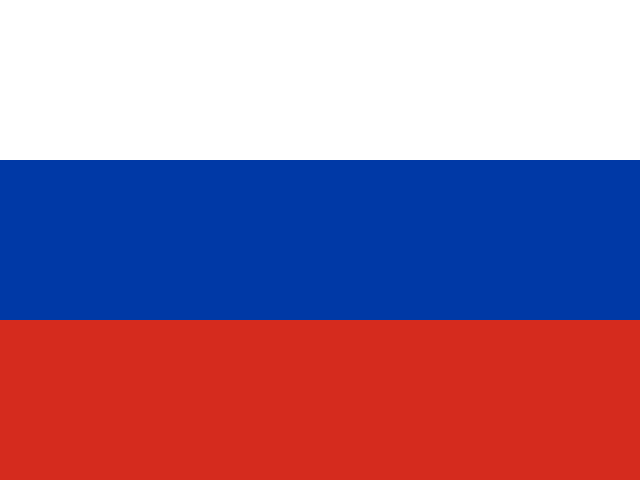 Russian Federation
 Exceptions and limitations for libraries
Since January 1, 2008, the fourth part of the Civil Code of the Russian Federation has been in force, which regulates relations in the field of copyright and related rights in detail.
It is covered in:
Section VII. Rights to the results of intellectual activity and means of individualization (Articles 1225 - 1551)
Chapter 70. Copyright (Articles 1255-1302)
Article 1274. Free use of a work for informational, scientific, educational or cultural purposes.
Article 1275. Free use of a work by libraries, archives and educational organizations
Chapter 71. Rights adjacent to copyright (Articles 1303–1344)
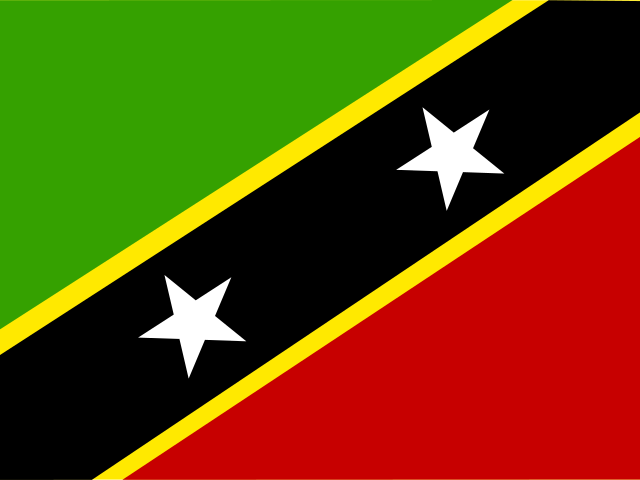 Saint Kitts and Nevis
 Exceptions and limitations for libraries
The copyright law of Saint Kitts and Nevis includes specific library provisions allowing librarians (or someone else on their behalf, or a library user, subject to an appropriate declaration) to make and provide users with a copy of an article, or part of another work, for research or private study purposes. Libraries can also supply such copies to other libraries. Libraries can also copy whole unpublished works (as long as the author has not said no to this) and can charge for this. Finally, libraries are allowed to copy works for preservation and replacement, unless it is possible to buy another copy reasonable. It is also possible to record broadcasts for archival purposes.
There appears to be no lending right in Saint Kitts and Nevis, and so no need for an exception to allow libraries to lend.
More widely, Saint Kitts and Nevis has a more flexible fair dealing exception for research, quotation and criticism. There is a broad exception for use of works in teaching, some possibility to use them in course-packs (although under restrictions), and limits on educational copying more broadly.
Saint Kitts and Nevis has yet to accede to the Marrakesh Treaty.
Copyright Act of Saint Lucia, No. 10 (6 September 1995) as amended by No. 7 (27 March 2000)
 Saint Lucia
 Exceptions and limitations for libraries
Libraries are able to make and supply copies of articles or parts of other works for users for the purposes of research or private study, with rules preventing repeat-copying and supply beyond the initial beneficiary. Where licences exist, these prime.
Libraries can also supply copies to other libraries, as long as it’s not possible to find someone who could give authorisation.
Libraries can preserve works, where it is not practical to buy a new copy. They can also copy unpublished works as long as there’s no explicit bar on such copying. In both this case, and in that of supply to authors, the library is supposed to charge a fee in order to cover costs.
There is a lending right, but this only applies to audio-visual works.
More broadly, St Lucia has a fair dealing exception for research and private study, and for criticism, review and reporting, with fairness based on an assessment of the nature of the work, the extent and substantiality of the part copied, and the effect of use on the market. There are also limited exceptions for use of works in education, and encouragement to use licences where available.
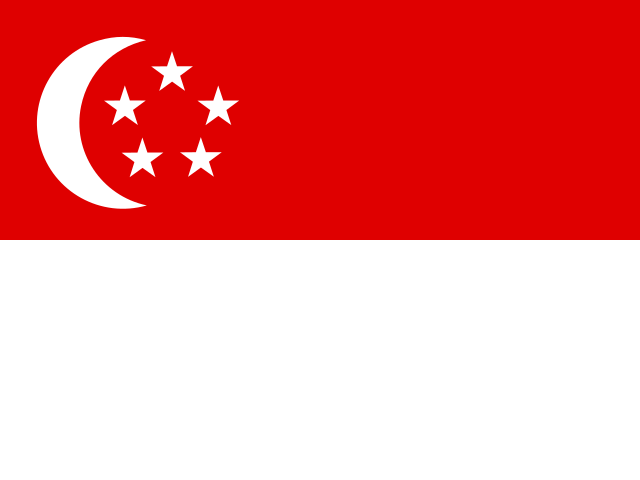 Singapore
 Exceptions and limitations for libraries
Revised Edition 2006 of the Copyright Act (Division 5 - Copying of Works in Libraries) allows the libraries to make copies of works, including digital copies. The Copyright Act (Division 7 - Copying of Works in Institutions Assisting Persons with Reading Disabilities and Institutions Assisting Intellectually Handicapped Readers) allow libraries to make and share accessible format copies of works for people with print disabilities.
 Suriname