Learn about the formal qualifications and certifications required to work in the library and information sector. These standards ensure librarians have the expertise to deliver quality services and uphold professional practices.
Professional Qualification Requirements
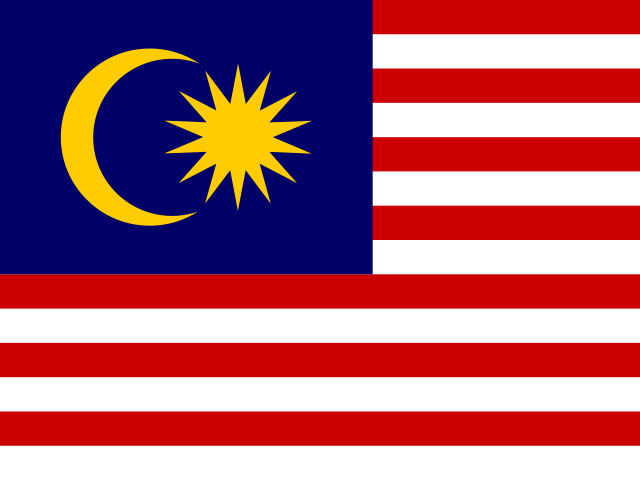 Malaysia
Public Services Commission of Malaysia requires formal professional qualification for librarian position as follows: 1) Bachelor of Library and Information Studies, 2) Masters in Library and Information Studies.
Professional Qualification Requirements
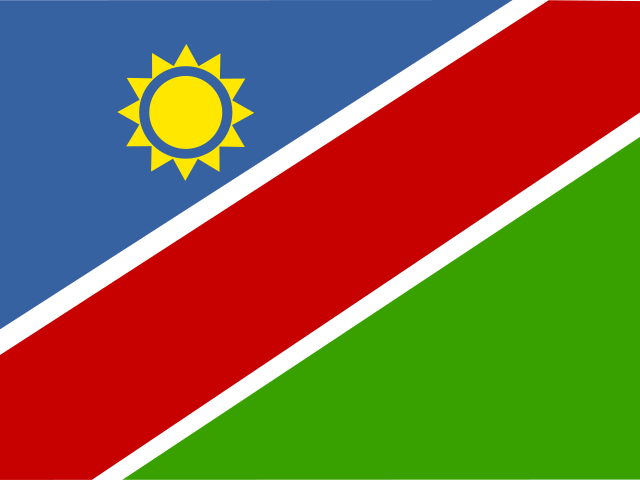 Namibia
To become a professional Librarian, one needs a BA Degree in Library and Information Studies NQF L7 for the entry Librarian position and for Assistant Librarian, it requires a Diploma in Library Science. The qualification requirements are set for all library types in the Government structure.
Professional Qualification Requirements
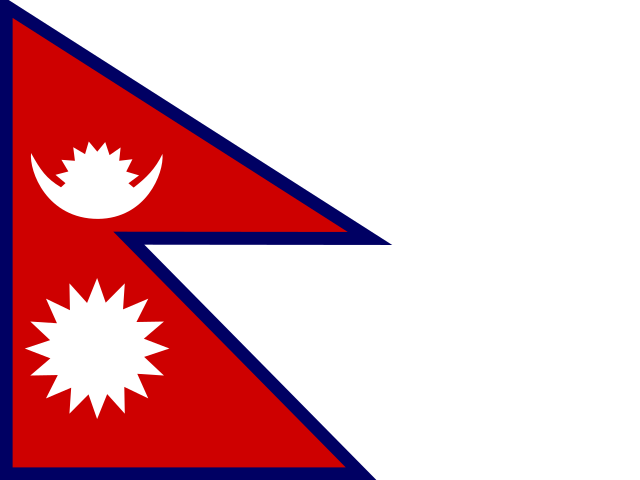 Nepal
Nepal
Public Service Commission of Nepal has designed the minimum qualification and requirement for a number of positions.
- Gazetted Second Class [Officer level civil servants] – Master in Library and Information Science (MLIS)
- Gazetted Third Class [Officer level civil servants] – Bachelor in Library and Information Science (B.Lib.I.Sc.)
- Non Gazetted [Non-officer level employees] – 1st class – B.Lib.I.Sc. or equivalent and 35 days LIS Training
- Non Gazetted [Non-officer level employees] – 2nd class – SEE and 35 days LIS Training at Tribhuvan University, Purbanchal University or other Universities
- Librarian – MLIS
- Associate Librarian – MLIS
- Deputy Librarian – B.Lib.I.Sc.
- Library Officer – Graduate in B.Lib.I.Sc. or Graduate in any other subject.
Professional Qualification Requirements
 Republic of Korea
In Korea, to be authorised to work in a library, one must obtain a librarian certificate. They are accessible to graduates who majored in Library and Information Science at a university and who have graduated or have recognized equivalent academic background in the Act, and who majored in Library and Information Science (See Libraries Act, Article 43 of Chapter 6 of PERSONNEL AND FACILITIES OF LIBRARIES). Currently, four-year universities, two-year colleges, and designated educational institutions are providing related education.
The librarian certificates are issued by the Minister of Culture, Sports and Tourism, to a person who meets certain qualification requirements as prescribed by the Ordinance of the Ministry of Culture, Sports and Tourism. Types of librarian qualifications include Certified Librarian (1st Grade), Certified Librarian (2nd Grade), Associate Librarian, according to the library law.
Professional Qualification Requirements
 Republic of Moldova
The Law on Libraries admits that the employment of the deputy director and deputy director of the public library shall be carried out by contest, based on the criteria of professional and managerial competence. In order to appreciate the activity, the level of professional knowledge and skills, as well as in order to stimulate the improvement of the professional skills and to increase the efficiency of the activity, the personnel in the public libraries are subject to attestation every 5 years. The certification of public library specialists is carried out by the Ministry of Education, Culture and Research jointly with other central and local public authorities, which have subordinated libraries, under a regulation approved by the Ministry of Education, Culture and Research.
Professional Qualification Requirements
 Russian Federation
There are established qualification requirements. Professional duties: to comply with duties based on the department or work site (acquisition, processing, cataloguing, IT, accounting, storage, reader services, subscriptions, etc.); to partake in the research and methodological activities, to execute development plans and other library programs. Required knowledge: laws and other normative legal acts of the Russian Federation regulating libraries and archives; the foundations of librarianship and bibliography; the key library technological processes; various forms and methods of serving the readers; the basics of labour legislation; internal policies and procedures; job and fire safety rules.
Professional Qualification Requirements
 Saint Kitts and Nevis
The chief librarian must have a degree in the field of library studies. Staff who are required to have a degree in LIS acquire it from foreign universities. General staff receive local training.
Professional Qualification Requirements
 Saint Lucia
There are professional qualification requirements set for public librarians, which were listed in the St Lucia Budget document 1986-1991 Appendix C, prepared by the St Lucia Government.
The required qualifications vary for different positions at the Public Library and include both certain professional training and a number of years of relevant experience.
Non-governmental libraries such as academic and special libraries have their own qualification requirements and salary scales.
Professional Qualification Requirements
 Suriname
Suriname strives to strengthen the professional qualification requirements and the formal library training offer within the field. Librarians are required to have one of the following - diploma "Librarian", diploma "Libary Assistant", or certificate "Library Employee". Other staff members, who have a high school diploma, are trained on-the-job.
Professional Qualification Requirements
 United Arab Emirates
There are no formal professional qualification requirements in the United Arab Emirates. However, some positions require certain qualification, and it depends on the library management. Required professional qualifications may include:
- Bachelor's degree in Library and Information Science
- Master's degree in Library and Information Science
- Library and Information Systems Diploma
- Information management Certificate
Professional Qualification Requirements
 United Kingdom of Great Britain and Northern Ireland
Librarianship in the UK is a recognised profession governed by what is known as a 'voluntary regulatory framework', which is overseen by CILIP as the Chartered Institute. Technically, anyone can apply for and get a job as a librarian or library worker, so it is not a requirement of employment to have a professional qualification or certification. However, progression in most sectors does depend on some form of professional certification. CILIP maintains a Register of Practitioners and offers three 'levels' of professional recognition - Chartership, Certification and Fellowship. They also support three 'routes' into professional practice - apprenticeship, qualifications and on-the-job learning and CPD.
Professional Qualification Requirements
 Zimbabwe
The professional qualification requirements in Zimbabwe are largely dependent on the Private, Public and Academic sector one wishes to work in. The President of the Republic of Zimbabwe, Cde. Emmerson Dambudzo Mnangagwa launched the Zimbabwe National Qualifications Framework (ZNQF) on Tuesday, 11 July 2018. The ZNQF seeks among many objectives, to provide a mechanism to harmonise national qualifications, enable vertical and horizontal mobility of learners and graduates. There is an ongoing discussion by information professionals on the impact of the ZNFQ in relation to work qualification requirements.